 DAILYINFOGRAPHICS.EU
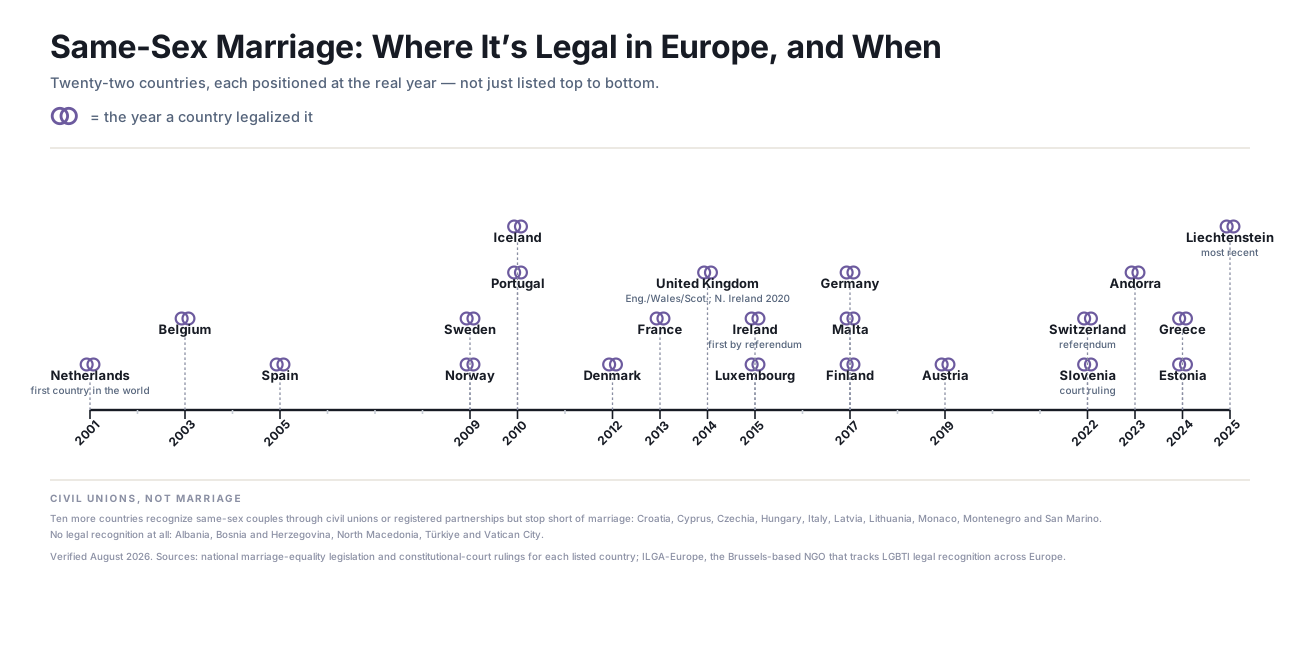
The Netherlands became the first country in the world to open marriage to same-sex couples, on 1 April 2001. Nearly a quarter-century later, twenty-two European countries have followed — the most recent, Liechtenstein, on 22 September 2025. The gap between the first and the twenty-second isn’t one long wave; it came in three distinct clusters, each with a different driver.
Three waves, not one
The first wave, through the 2000s, was Northern and Western European and almost entirely legislative: the Netherlands, Belgium, Spain, Norway, Sweden, Portugal and Iceland all passed marriage-equality laws between 2001 and 2010. The second wave, from 2012 to 2019, added Denmark, France, the United Kingdom, Luxembourg, Ireland, Finland, Malta, Germany and Austria. The United Kingdom’s date is really three dates: England and Wales in March 2014, Scotland in December 2014, and Northern Ireland only in January 2020 — six years later, and after Westminster legislated directly rather than waiting on Stormont. Ireland’s 2015 vote stands out for a different reason: it was the first country in the world to legalize same-sex marriage by popular referendum rather than a parliamentary act or court order.
The third and most recent wave is smaller and arrived almost entirely through courts and referendums instead of parliaments: Switzerland in 2022 by public vote, Slovenia the same year by constitutional court ruling, then Andorra in 2023, Estonia and Greece in 2024, and Liechtenstein in 2025.
Civil unions, not marriage
Ten more European countries recognize same-sex couples through civil unions or registered partnerships but stop short of marriage: Croatia, Cyprus, Czechia, Hungary, Italy, Latvia, Lithuania, Monaco, Montenegro and San Marino. Italy is the largest and most striking name on that list — a G7 economy and founding EU member that has offered civil unions since 2016 but hasn’t brought a marriage bill to a vote since.
Where there's no recognition at all
Beyond the civil-union tier, a further group of European countries offers no legal recognition of same-sex couples in any form, including Albania, Bosnia and Herzegovina, North Macedonia, Turkey and Vatican City. It's a shorter list than either of the other two tiers, but the legal gap it represents is often the widest of the three — in several cases, bordering directly on a country with full marriage rights.
Where it goes from here
Every addition to the marriage list in the past decade has come from a court ruling or a referendum, not a governing party campaigning on it — Ireland in 2015, Switzerland and Slovenia in 2022, Estonia and Greece in 2024. The pattern suggests the next country to move is more likely to be one with an active constitutional challenge or a scheduled referendum already in motion than one waiting on a parliamentary majority.
Outside the marriage-and-civil-union tiers, three countries have live proposals worth watching, all still short of a marriage law: Poland's government committed in December 2023 to a partnership bill, and in May 2026 its parliament passed a narrower "closest person" cohabitation-rights measure that still needs Senate and presidential sign-off; Kosovo's prime minister announced an intention to legalize same-sex unions in April 2024; and Ukraine's parliament is weighing a civil-partnership bill even as a January 2026 draft civil code would explicitly bar same-sex partnerships instead. None of the three is close to full marriage equality yet, but each is a step ahead of having no proposal on the table at all.
Sources
National marriage-equality legislation and constitutional-court rulings for each listed country, including the Netherlands’ Marriage by Same-Sex Couples Act (2000, effective 2001) and the UK’s Marriage (Same Sex Couples) Act 2013 and Northern Ireland (Executive Formation etc.) Act 2019 · ILGA-Europe, the Brussels-based NGO that tracks LGBTI legal recognition across Europe.