 DAILYINFOGRAPHICS.EU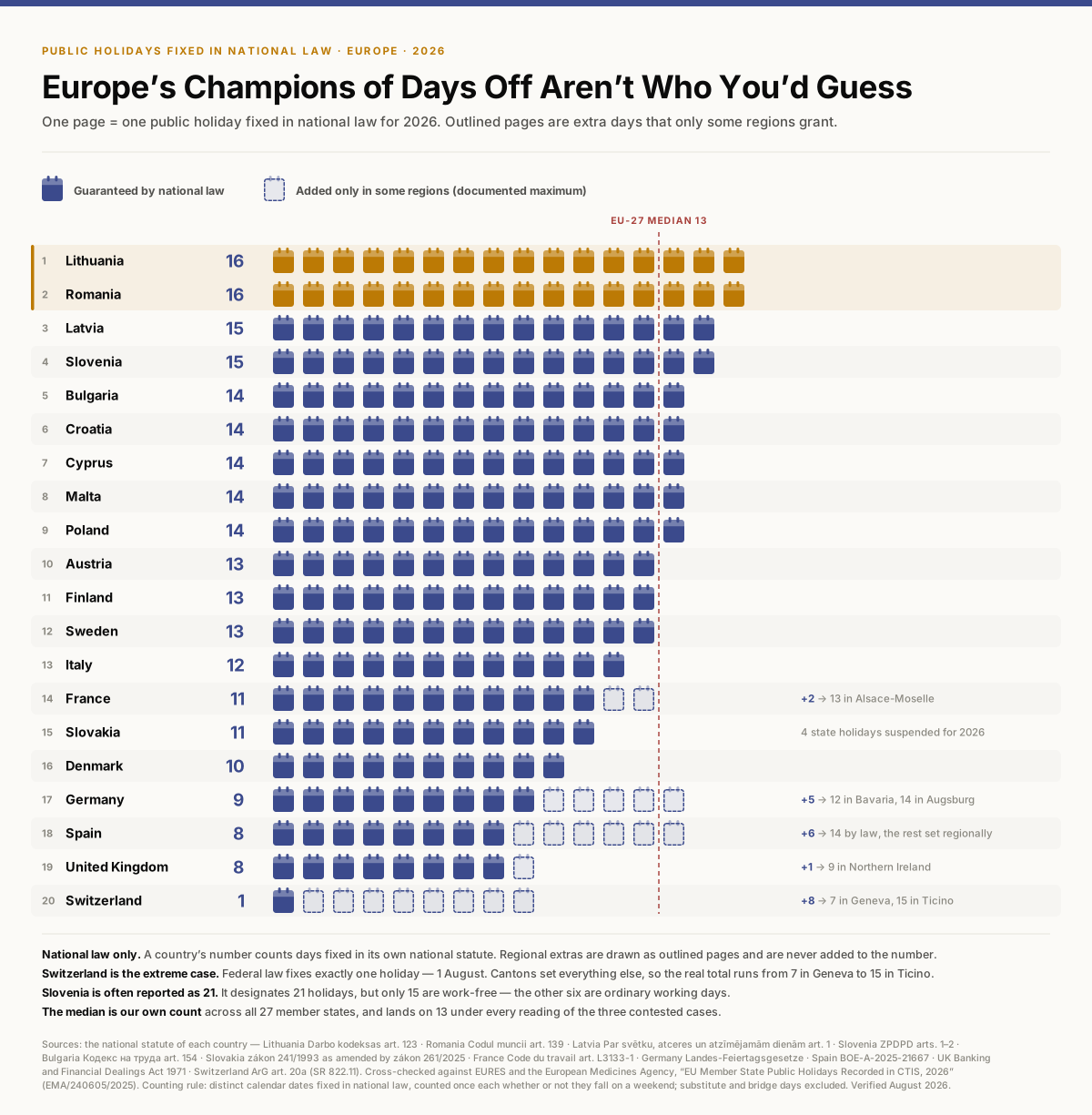
Slovenia is credited online with 21 public holidays — more than any other European country. That figure is real, in one sense: Slovenia’s ZPDPD statute designates 21 days. But only 15 of them are actually work-free; the other six, including Primož Trubar Day and Rudolf Maister Day, are ordinary working days that happen to be officially marked. The “21” figure that circulates everywhere is both categories added together.
The real leaders
Once the count is restricted to holidays that are both fixed in national law and genuinely work-free, Lithuania and Romania tie for the actual lead at 16 each. Latvia and Slovenia (properly counted) follow at 15. Sweden, often cited at 16, is really 13 — Julafton, Midsommarafton and Nyärsafton are customary half-days, not statutory holidays.
Switzerland's number depends entirely on where you live
Switzerland’s federal law fixes exactly one nationwide holiday: 1 August. Everything else is set canton by canton, so the real total for any Swiss resident ranges from 9 in Geneva to 15 in Ticino. The same national-vs-regional gap shows up, smaller, in Germany (9 national, up to 14 in Augsburg), Spain (8 by law, up to 14 regionally) and the UK (8 in most of the country, 10 in Northern Ireland).
The pattern behind the national-versus-regional gap
Germany, Spain and Switzerland all share the same structure: a modest national floor, set by federal or central law, topped up by extra days that individual states, regions or cantons are free to grant on their own. Germany's federal floor is 9; some states, including the Augsburg area, add enough regional days to reach 14. Spain's national law fixes 8; some autonomous communities add regional days to reach up to 14. Switzerland takes that logic furthest of all, fixing only a single federal holiday and leaving the rest entirely to the cantons. The practical effect is that "how many public holidays does this country have" often isn't a single number at all — it depends on which town someone actually lives in, which is exactly why this page counts by national law first and marks regional extras separately rather than folding them into one national total.
Frequently asked questions
Why is Slovenia credited with 21 public holidays if only 15 are actually work-free?
Slovenia's ZPDPD statute designates 21 days in total, but six of them — including Primož Trubar Day and Rudolf Maister Day — are ordinary working days that happen to be officially marked, not days off. The widely circulated “21” figure adds both categories together.
Which country actually has the most public holidays?
Lithuania and Romania tie for the real lead, at 16 each, once the count is restricted to holidays that are both fixed in national law and genuinely work-free.
Is Sweden's public holiday count really 16, as often cited?
No, it's really 13. Julafton, Midsommarafton and Nyårsafton are customary half-days, not statutory holidays, and shouldn't be counted alongside them.
How many public holidays does someone in Switzerland actually get?
It depends entirely on canton. Federal law fixes exactly one nationwide holiday, 1 August; everything else is set canton by canton, so the real total ranges from 9 in Geneva to 15 in Ticino.
Why did Slovakia's holiday count drop in 2026?
A 2025 law suspended four state holidays for the year, bringing Slovakia's 2026 total to 11, not the 15 sometimes still quoted.
Do all UK residents get the same number of public holidays?
No. Most of the UK has 8 statutory holidays, but Northern Ireland has 10.
Sources
National statute of each country — Lithuania Darbo kodeksas art. 123 · Romania Codul muncii art. 139 · Latvia likumi.lv · Slovenia ZPDPD arts. 1–2 · Bulgaria Labour Code art. 154 · Slovakia zákon 241/1993 as amended by zákon 261/2025 · France Code du travail art. L3133-1 · Germany Landes-Feiertagsgesetze · Spain BOE-A-2025-21667 · UK Banking and Financial Dealings Act 1971 · Switzerland ArG art. 20a. Cross-checked against EURES and the European Medicines Agency, “EU Member State Public Holidays Recorded in CTIS, 2026” (EMA/240605/2025). Verified August 2026.