 DAILYINFOGRAPHICS.EU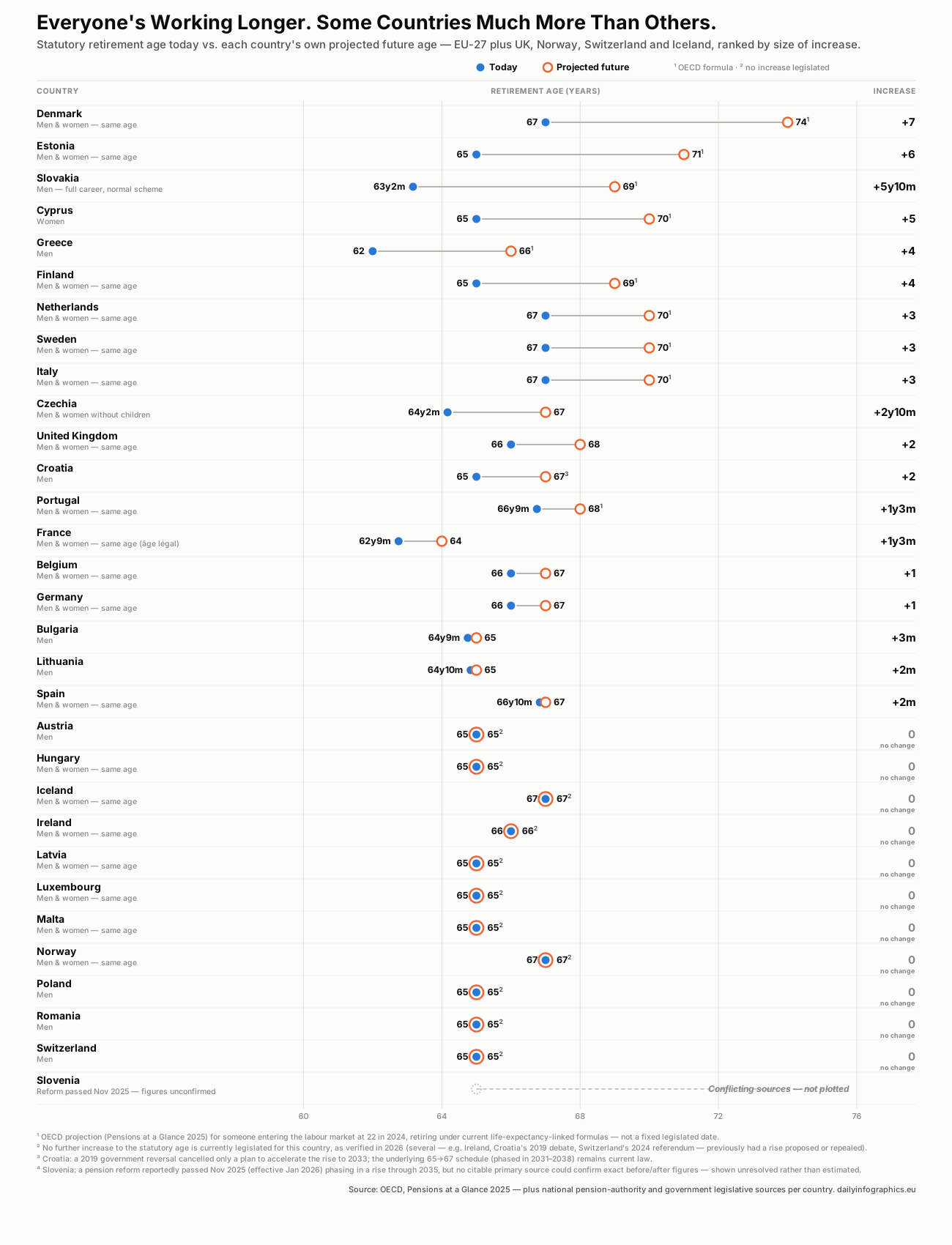
Denmark's statutory retirement age is on course to rise from 67 today to 74 — a seven-year increase, the largest of any country in this now-complete 31-country comparison. Estonia (64y9m→71) and Slovakia (63y2m→69) follow close behind. At the other end, eleven countries — including Austria, Poland, Norway, Switzerland and Romania — currently have no increase legislated at all.
Two different kinds of "future"
Not every projected figure here means the same thing. Ten of the thirty-one rows — Denmark, Estonia, Slovakia, Cyprus, Greece, Finland, the Netherlands, Sweden, Italy and Portugal — carry an OECD-formula footnote: their future age is a projection for someone entering the labour market at 22 in 2024, retiring under a life-expectancy-linked formula, not a date fixed by statute. The UK's rise to 68 and Germany's rise to 67, by contrast, are already written into current law. That distinction matters more than it looks: a formula-linked projection can still move if life expectancy comes in differently than assumed; a legislated date is comparatively locked in. Each row here is footnoted accordingly.
Why index instead of legislate
The logic behind automatic indexing is simple, even where the politics aren't. Denmark, Estonia and Finland peg their future retirement age to measured life expectancy rather than to a number a parliament has to re-pass every few years: as people are projected to live longer, the age moves with them, on a schedule set out in advance. The general aim, as pension authorities in those countries describe it, is to keep the expected number of years spent in retirement roughly stable as longevity rises, instead of fixing a number and letting that ratio drift. Countries that skip the formula, like the UK and Germany, trade that automation for certainty: today's legislated 68 and 67 won't move on their own, but reaching the next number takes an actual act of parliament, not an updated mortality table.
One number, several definitions
The figure in each row isn't always the same kind of number. Some are the plain statutory age, identical for men and women. Others are one specific case standing in for a headline figure: Slovakia's is for a full career under the normal scheme, Greece's and Croatia's rows list the male age, Cyprus's lists the female one. France pushes this furthest — it runs three separate legal ages at once: a legal minimum, a maximum, and a full-pension age that sits between them.
France's real metric is clearer now, but not settled: the “âge légal” (legal minimum age) was on track to rise from 62y9m to 64, a cleaner same-metric comparison than the full-pension age that caused confusion in an earlier version of this piece — until the French Parliament suspended the 2023 pension reform in a November 2025 budget vote, freezing the âge légal at 62y9m–63y9m until 2028.
Why retirement ages are rising at all
None of this is happening in a vacuum. A pay-as-you-go pension system — where today's contributions fund today's pensioners, rather than each worker banking their own account — is built around an assumed ratio of working years to retirement years. Life expectancy at 65 has been rising across the OECD for decades, which means fewer active contributors are now funding more years of retirement per pensioner than most of these systems were designed for. Raising the retirement age, whether by formula or by statute, is the most direct lever governments have to keep that ratio from drifting further — which is also why the political fights over doing it are rarely really about the number itself.
Frequently asked questions
Which country has the biggest projected increase in retirement age?
Denmark, whose statutory retirement age is on course to rise from 67 today to 74 — a seven-year increase, the largest in this 31-country comparison. Estonia (64y9m→71) and Slovakia (63y2m→69) follow behind it.
Do all 31 countries in this comparison have a legislated increase?
No. Eleven of the 31 countries covered — including Austria, Poland, Norway, Switzerland and Romania — currently have no increase legislated at all, so their retirement age is shown unchanged going forward.
Why do some countries index retirement age to life expectancy instead of just legislating a fixed number?
Denmark, Estonia and Finland peg their future retirement age to measured life expectancy rather than to a figure a parliament has to re-pass periodically. As people are projected to live longer, the age moves with them on a pre-set schedule, aiming to keep the expected number of years spent in retirement roughly stable as longevity rises. The UK and Germany trade that automation for certainty: their legislated ages of 68 and 67 won’t move on their own, but reaching a higher number takes an actual act of parliament.
Why is Slovenia shown differently from the other 30 countries?
An earlier version of this piece marked Slovenia as a dashed “conflicting sources — not plotted” row because no citable primary source could confirm the exact figures. That’s now resolved: OECD’s Slovenia country report (Pensions at a Glance 2025, November 2025) and a Slovenian government release put the statutory retirement age rising from 65 to 67.
Why are governments raising the retirement age at all?
Most of these systems are pay-as-you-go, meaning today’s contributions fund today’s pensioners rather than each worker banking their own account, built around an assumed ratio of working years to retirement years. Life expectancy at 65 has been rising across the OECD for decades, so fewer active contributors are now funding more years of retirement per pensioner than these systems were designed for. Raising the retirement age is the most direct lever governments have to keep that ratio from drifting further.
Sources
OECD, Pensions at a Glance 2025 · national pension-authority and government legislative sources per country, compiled and verified August 2026.