 DAILYINFOGRAPHICS.EU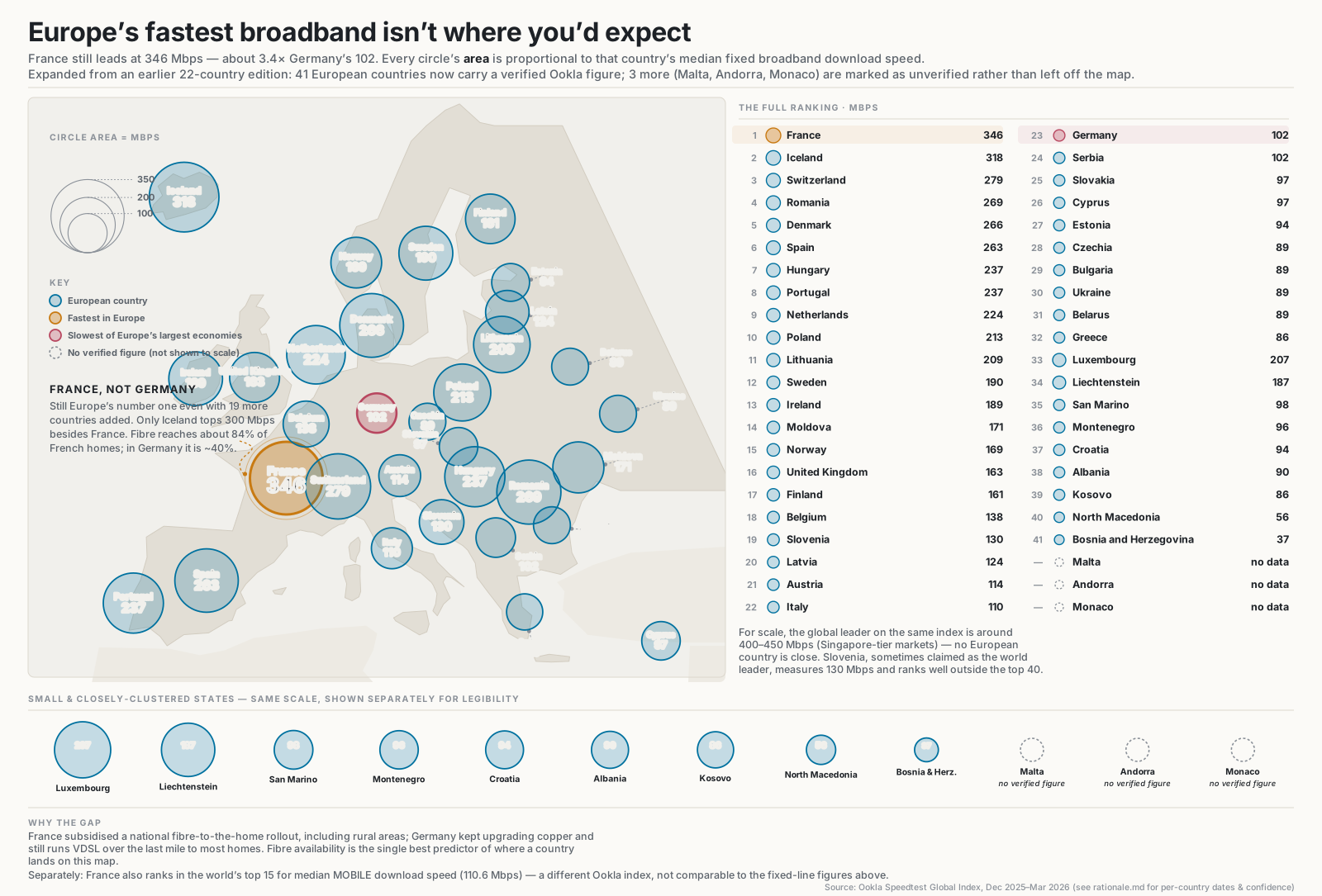
France has Europe's fastest fixed broadband, at a median 346 Mbps. That held up when this map was expanded from an initial 22 countries to 41 — no newly-added country came close, and only Iceland (318 Mbps) sits in the same tier. The gap to the slowest of Europe's largest economies, Germany (102 Mbps), comes down to one infrastructure choice: France subsidised a national fibre-to-the-home rollout that reaches rural areas, while Germany kept upgrading its copper network and still runs VDSL over the last mile into most homes. Fibre reaches about 84% of French households; in Germany it's roughly 40%.
Why Germany, specifically
The gap isn't new and it isn't an accident. Deutsche Telekom, the former state monopoly and still the dominant incumbent, spent much of the last decade upgrading its copper network with VDSL vectoring rather than trenching fibre to the home — a cheaper, faster fix that squeezed more speed out of infrastructure already in the ground. For a while that felt sensible: fibre looked like an expensive solution to a problem VDSL had already patched over. Cable operators added a second, competing strand of legacy infrastructure on top, further dulling the case for anyone to dig up streets. France treated fibre-to-the-home as a national project early, with subsidies reaching rural areas a purely commercial rollout would have skipped. Germany has since set its own federal fibre targets, but a national access network doesn't get rebuilt on a few years' notice — and this chart reflects the connections households have today, not the ones a target promises later.
What “median” is actually filtering out
It's worth being precise about what this number measures. Ookla's index is built from tests real users ran on their own live connections — not the figure printed on an ISP's contract. Median, rather than average, is the deliberate choice: it isn't pulled upward by someone testing a fresh line over ethernet at 2am, and it isn't pulled downward by someone testing over a weak signal three rooms from the router. What's left approximates what a typical connection delivers on an ordinary day. An advertised “up to” figure describes a plan's ceiling; this index describes something closer to its floor.
Size isn't the pattern it looks like
It's tempting to read a leaderboard like this as small, dense countries winning by default — less distance between homes, cheaper fibre per household connected. Iceland and Switzerland, both compact and wealthy, sit near the top, which fits that theory well enough. It breaks down at the very top, though: France is one of Europe's most populous countries, not a small or compact one, and it still leads outright. Whatever advantage geography hands small countries, it isn't the deciding factor here. The countries at the top chose to build fibre into rural areas a purely commercial rollout would bypass; the countries further down generally bet a cheaper upgrade would hold up longer than, in most cases, it has.
Not Slovenia, and not Singapore either
Slovenia is sometimes cited online as having the world's fastest internet. On the same Ookla Speedtest Global Index used throughout this piece, Slovenia's median speed has since climbed roughly 54% to about 200 Mbps, but it still ranks only around 39th worldwide as of June 2026 — well behind France, Iceland, Switzerland, Romania, Denmark and Spain. The actual global leader on this index sits around 400–450 Mbps, Singapore-tier; no European country is close.
Three countries — Malta, Andorra and Monaco — are shown on the map at their correct position but marked explicitly as having no verified figure, rather than left off. Malta's own sources spread from 187 to 210 Mbps without converging closely enough to plot with confidence; no Ookla-sourced figure could be found for Andorra or Monaco at all.
France also places in the world's top 15 for mobile download speed (a median 110.6 Mbps as of January 2025) at a low $0.20 per gigabyte — but mobile and fixed broadband are separate indices measuring different things, and the two figures shouldn't be blended into one ranking.
Frequently asked questions
Why is France's broadband so much faster than Germany's, despite Germany being the larger economy?
The gap comes down to one infrastructure choice: France subsidised a national fibre-to-the-home rollout that reaches rural areas, while Germany's dominant incumbent spent the last decade upgrading its existing copper network with VDSL vectoring instead of trenching fibre. Fibre reaches about 84% of French households against roughly 40% in Germany, and a national access network doesn't get rebuilt on a few years' notice.
What does “median” download speed actually measure, versus an advertised broadband speed?
Ookla's index is built from tests real users ran on their own live connections, and it uses the median rather than the average specifically so no single very fast or very weak test skews the result. What's left approximates what a typical connection delivers on an ordinary day — closer to a connection's floor than the ceiling implied by an advertised “up to” plan speed.
Do small, dense countries always win on internet speed?
Not reliably. Iceland and Switzerland, both compact and wealthy, sit near the top, which fits that theory well enough, but it breaks down at the very top: France is one of Europe's most populous countries and still leads outright. The countries that lead chose to build fibre into rural areas a purely commercial rollout would bypass; size alone doesn't explain the ranking.
Is Slovenia really home to the “world's fastest internet,” as sometimes claimed online?
No. On the same Ookla Speedtest Global Index used throughout this piece, Slovenia's median speed has risen to about 200 Mbps but it still ranks only around 39th worldwide as of June 2026, well behind France, Iceland, Switzerland, Romania, Denmark and Spain. The actual global leader on this index sits around 400–450 Mbps, Singapore-tier, and no European country is close.
Why do Malta, Andorra and Monaco appear on the map without a plotted speed?
They're shown at their correct position but flagged as having no verified figure rather than being left off entirely. Malta's own sources spread from 187 to 210 Mbps without converging closely enough to plot with confidence, and no Ookla-sourced figure could be found for Andorra or Monaco at all.
Does France's fast fixed broadband mean its mobile internet is also world-class?
Not automatically. France does place in the world's top 15 for mobile download speed, a median 110.6 Mbps as of January 2025 at a low $0.20 per gigabyte, but mobile and fixed broadband are separate Ookla indices measuring different networks, and the two figures shouldn't be blended into one ranking.
Sources
Ookla Speedtest Global Index, median fixed broadband download speed, primarily December 2025 (UK corroborated against a March 2026 reading). Cross-checked across worldpopulationreview.com, Wikipedia, statranker.org, datapandas.org and SpeedGEO.net — every figure required agreement across at least two independently-fetched sources before being plotted.