 DAILYINFOGRAPHICS.EU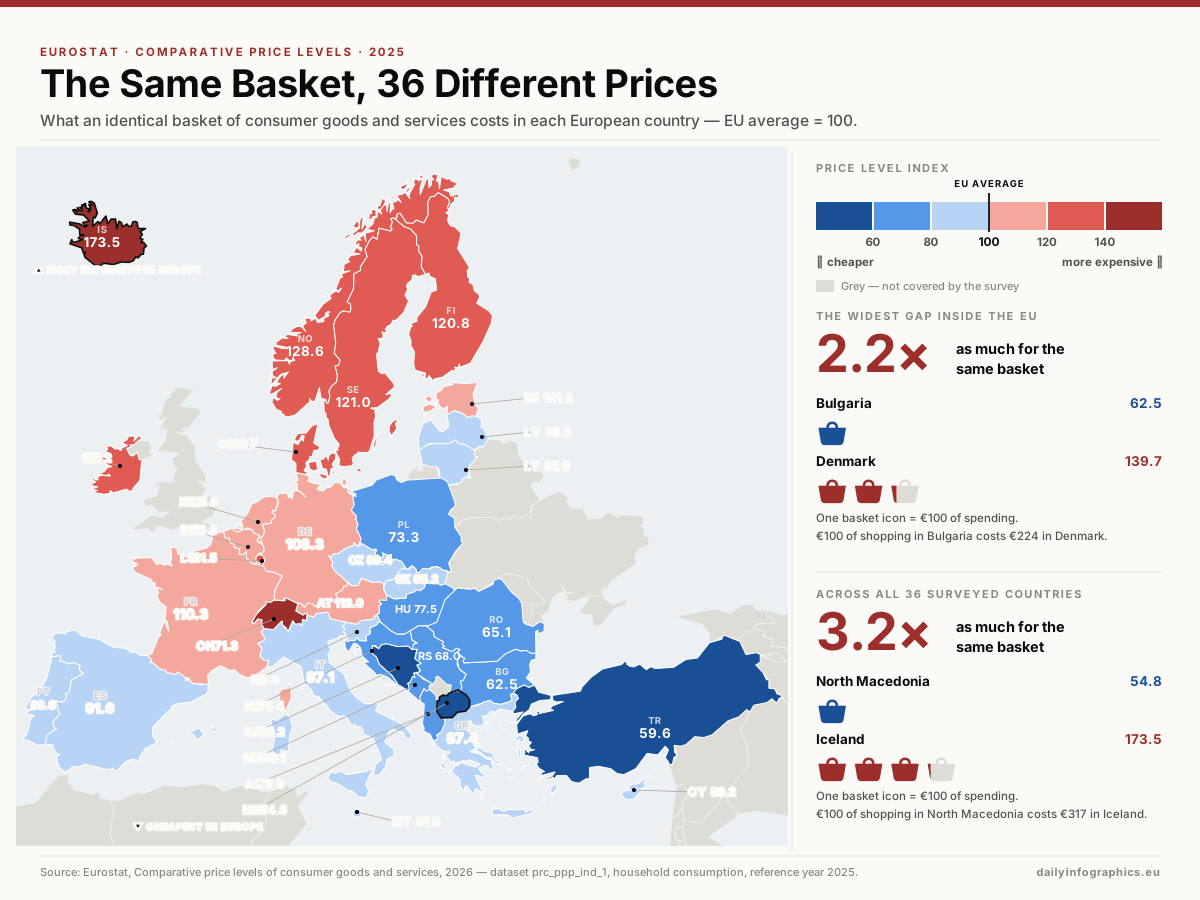
An identical basket of consumer goods and services costs 2.2 times more in Denmark than in Bulgaria — both EU members, both using the price-level index Eurostat publishes for exactly this comparison. Widen the lens to all 36 countries the survey covers (the EU’s 27, three EFTA countries, and six EU candidate countries) and the gap grows to 3.2 times, between Iceland and North Macedonia.
A correction worth stating plainly
Early drafts of this piece used figures for Iceland, Switzerland, Denmark, Ireland and Norway that turned out to trace back to an AI-generated aggregator blog, not Eurostat itself. The real numbers, pulled directly from Eurostat’s dissemination API (dataset prc_ppp_ind_1, reference year 2025): Iceland 173.5, Switzerland 171.3, Denmark 139.7, Ireland 136.2, Norway 128.6. Within the EU, the true extremes are Denmark (139.7) and Bulgaria (62.5) — not Luxembourg and Romania, which are expensive and cheap respectively but not the two furthest apart.
Luxembourg (131.5) and Romania (65.1) are both still near the ends of the EU range — just not the actual extremes once every country is checked against the source.
What the index is actually measuring
The comparative price level is a purchasing-power measure, not a currency-exchange one: it prices the same fixed basket of household consumer goods and services in every country's own shops, then expresses each country's result relative to the EU average of 100. That's why a country can score high on this index even when its currency isn't especially strong — Iceland and Switzerland both sit outside the euro, and both still land at the top of the 36-country list. It's also why the index moves slowly: retail prices, rents, and service costs shift far less from one year to the next than exchange rates do, which is part of why Eurostat re-runs this survey on a fixed annual cycle rather than tracking it in real time.
Frequently asked questions
What does a price-level index of 100 mean?
100 is the EU average, by definition. A country scoring below 100 has a cheaper-than-average basket of consumer goods and services; a country above 100 has a more expensive one.
Why does this page mention a correction?
Early drafts used figures for Iceland, Switzerland, Denmark, Ireland and Norway that traced back to an AI-generated aggregator blog rather than Eurostat itself. The figures were replaced with numbers pulled directly from Eurostat's own dissemination API.
Which EU country actually has the highest price level?
Denmark, at 139.7 — not Luxembourg, which is commonly assumed to top the EU list.
Which EU country has the lowest price level?
Bulgaria, at 62.5 — not Romania, which is commonly assumed to be the cheapest.
Are Luxembourg and Romania still expensive and cheap, even if they're not the extremes?
Yes. Luxembourg (131.5) and Romania (65.1) both sit near the ends of the EU range — just not the actual extremes once every country is checked against the Eurostat source.
Why is the gap wider when non-EU countries are included?
The 36-country survey adds Iceland (173.5), which tops the entire list, and North Macedonia (54.8), which sits at the bottom — producing a 3.2x gap, versus 2.2x when the comparison is limited to EU members only.
Sources
Eurostat, Comparative price levels of consumer goods and services — dataset prc_ppp_ind_1, reference year 2025, retrieved directly from the Eurostat dissemination API. Cross-checked against Eurostat Statistics Explained. Base map: Natural Earth 1:50m.