 DAILYINFOGRAPHICS.EU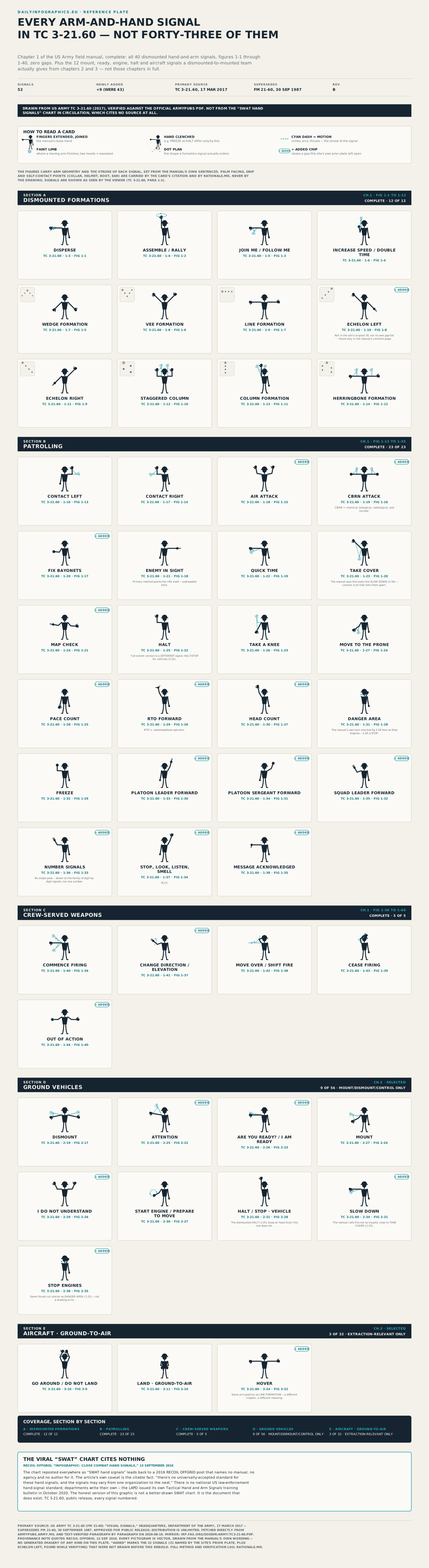
The “SWAT hand signals” chart reposted everywhere traces back to a single 2016 RECOIL OFFGRID post that names no manual, no agency and no author. The article’s own caveat is the citable fact: “there’s no universally-accepted standard for these hand signals, and the signals may vary from one organization to the next.” There is no national US law-enforcement hand-signal standard — departments write their own; the LAPD issued its own Tactical Hand and Arm Signals training bulletin as recently as October 2020. What actually exists is us army hand signals not forty-three: the cited field manual below, not the uncredited chart everyone keeps reposting.
This infographic draws from the document that does exist instead: the US Army’s TC 3-21.60, “Visual Signals” (17 March 2017), which superseded FM 21-60 (30 September 1987). It is public-release, unlimited distribution, and every signal is numbered against its own chapter and figure.
Two hands, one arm, and a stroke
Nearly every signal in TC 3-21.60 is built from two hand positions, the angle of the arm, and the part that reposted charts throw away entirely: a motion. The manual specifies strokes — “wave in large, horizontal circles,” “thrust the fist upward… several times,” “move it through a wide horizontal arc.” A still icon of a pose is not the signal; the accent colour on this sheet marks motion and nothing else.
Every signal, three sections, zero gaps
Chapter 1 splits into three sections, and this sheet completes every one of them: A, Dismounted Formations (12 of 12 — wedge, line, echelon, column and their variants), B, Patrolling (23 of 23 — movement rate, danger area, halt, freeze, take cover, enemy sightings, fire control), and C, Crew-Served Weapons (5 of 5 — the machine-gun and anti-armor team signals Chapter 1 covers on its own). Beyond Chapter 1, the sheet pulls in the handful of Chapter 2 (Ground Vehicles) and Chapter 3 (Aircraft) signals that a dismounted-to-mounted team actually gives in the field — mount, halt/stop vehicle, go around, load, and the ground-to-air and extraction calls — 9 of 56 vehicle signals and 3 of 32 aircraft signals, not the full chapters, because the rest are crew-internal or aircrew-internal signals a ground team never sends. Each signal still carries its TC 3-21.60 paragraph and figure number, so a reader can go straight to the source page.
TC 3-21.60, every arm-and-hand signal, not just forty-three
TC 3-21.60 is the only source this sheet cites, on purpose: every arm-and-hand signal here carries its own paragraph and figure number back to that manual, which is exactly what lets it go beyond the viral chart’s uncited forty-three and still be checkable line by line. Most of what circulates online calling itself us army hand signals not forty-three is a repost with no manual behind it — this sheet is us army hand signals, cited, from the actual field manual.
Frequently asked questions
Is there an official "SWAT hand signals" standard?
No. There is no national US law-enforcement hand-signal standard; individual departments write their own, and the LAPD issued its own Tactical Hand and Arm Signals training bulletin as recently as October 2020. The uncredited chart that circulates online as "SWAT hand signals" traces back to a single 2016 RECOIL OFFGRID post that names no manual, agency or author.
What manual do these signals actually come from?
The US Army's TC 3-21.60, “Visual Signals,” dated 17 March 2017, which superseded FM 21-60 from 30 September 1987. It is public-release, unlimited distribution, and every signal in it is numbered against its own chapter and figure.
Why isn't a still picture of a hand pose enough to show a signal?
Because the manual specifies a motion, not just a position — strokes like waving in large horizontal circles or thrusting a fist upward several times. A still icon captures the hand shape but throws away the part that actually carries the meaning.
Does this sheet cover all of Chapter 1, or just a selection?
All of it. Chapter 1 splits into three sections this sheet completes in full: Dismounted Formations (12 of 12), Patrolling (23 of 23), and Crew-Served Weapons (5 of 5), for all 40 dismounted signals.
Does the sheet also include vehicle or aircraft signals?
Yes, but only the ones a dismounted-to-mounted team actually gives in the field: 9 of the 56 Chapter 2 ground-vehicle signals and 3 of the 32 Chapter 3 aircraft signals, such as mount, halt/stop vehicle, load, and ground-to-air extraction calls. The rest are crew-internal or aircrew-internal signals a ground team never sends.
What's an example of an error the older charts got wrong?
Earlier printings conflated the "danger area" and "stop engines" signals into one. TC 3-21.60 draws them apart as two distinct signals, and this sheet follows the corrected version.
Sources
US Army TC 3-21.60 (FM 21-60) “Visual Signals,” Headquarters Department of the Army, 17 March 2017 — supersedes FM 21-60, 30 September 1987. Fetched directly from armypubs.army.mil and text-verified paragraph by paragraph on 2026-08-19. Provenance note on the uncredited viral chart references RECOIL OFFGRID, 13 September 2016.