 DAILYINFOGRAPHICS.EU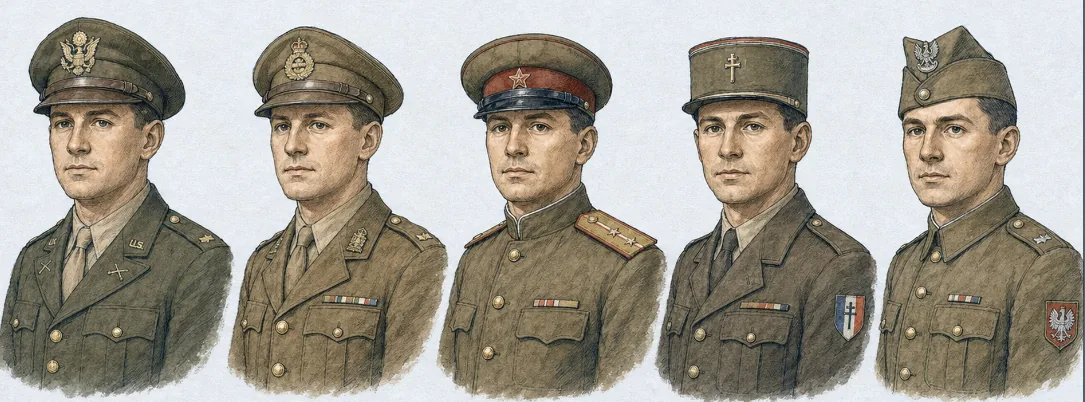
Five Allied armies fought World War II under five different rank systems, and none of them named their grades the same way. This table aligns all five by equivalent grade — OF-1a through OF-10 — rather than by title, so a British Second Lieutenant, a Soviet Mladshiy Leytenant, and a Polish Podporucznik can be read as the same rung on five different ladders.
| Army | OF-1a | OF-1b | OF-2 | OF-3 | OF-4 | OF-5 | OF-6 | OF-7 | OF-8 | OF-9 | OF-10 |
|---|---|---|---|---|---|---|---|---|---|---|---|
| United StatesUS Army | 2nd Lieutenant | 1st Lieutenant | Captain | Major | Lt Colonel | Colonel | Brigadier General | Major General | Lieutenant General | General | General of the Army |
| United KingdomBritish Army | Second Lieutenant | Lieutenant | Captain | Major | Lieutenant-Colonel | Colonel | Brigadier § | Major-General | Lieutenant-General | General | Field Marshal |
| Soviet UnionRed Army (RKKA) | Mladshiy Leytenant | Leytenant † | Kapitan | Mayor | Podpolkovnik | Polkovnik | General-mayor | General-leytenant | General-polkovnik | General armii | Marshal of the Soviet Union |
| FranceForces Françaises Libres | Sous-lieutenant | Lieutenant | Capitaine | Chef de bataillon | Lieutenant-colonel | Colonel | Général de brigade | Général de division | Général de corps d’armée | Général d’armée | Maréchal de France |
| PolandWojsko Polskie | Podporucznik | Porucznik | Kapitan ‡ | Major | Podpułkownik | Pułkownik | Generał brygady | Generał dywizji | Generał broni | — | Marszałek Polski |
← swipe to see all columns →
† The Red Army carried an extra grade, Starshiy Leytenant, between Leytenant and Kapitan — it has no clean Western equivalent. ‡ Rotmistrz was the cavalry’s own form of Kapitan, not a separate rank. § A British Brigadier sits at the OF-6 step but was not formally a general officer.
Why America suddenly needed a fifth star
Britain had held Field Marshal since 1736. The Soviet Union created Marshal of the Soviet Union in 1935. The United States had no five-star grade at all until Congress created General of the Army on 14 December 1944 (Public Law 78-482) — a rank invented specifically so that American theatre commanders would not be outranked inside a combined Allied headquarters. Four officers held it during the war: George Marshall, Douglas MacArthur, Dwight Eisenhower, and Henry “Hap” Arnold.
Reading the ladder
The Red Army carried an extra grade, Starshiy Leytenant, between Leytenant and Kapitan — it has no clean Western equivalent, so the table leaves that step annotated rather than force-matched. In the Polish army, Rotmistrz was simply the cavalry’s own form of Kapitan, not a separate rank in the ladder.
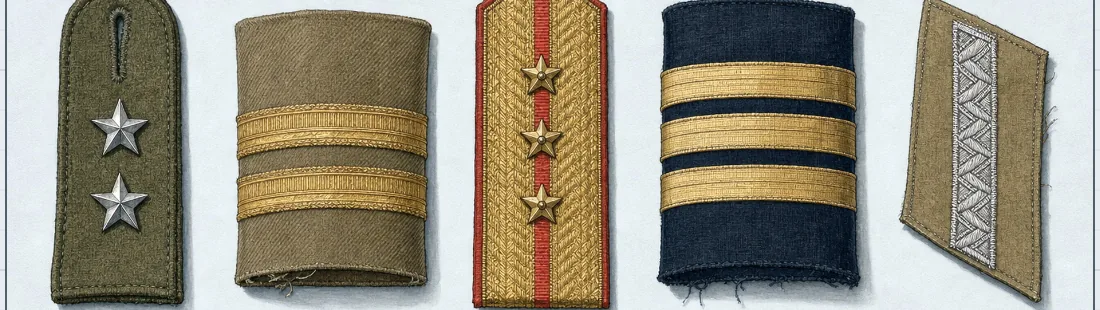
WW2 allied officer rank insignia, one ladder
That's the whole point of lining up rank insignia this way: a WW2 officer's grade should read the same whether you're looking at an American, British, Soviet, French or Polish shoulder board. Once the rank insignia is aligned to the OF-scale rather than to title, this world war 2 rank insignia comparison stops being five separate vocabularies and becomes one comparable rank — the same world war 2 rank insignia comparison works whether you start from the US Army or the Red Army.
Frequently asked questions
Why did the US create a five-star rank in the middle of World War II?
Congress created General of the Army on 14 December 1944 (Public Law 78-482) specifically so that American theatre commanders would not be outranked inside a combined Allied headquarters. Britain had held Field Marshal since 1736 and the Soviet Union had created Marshal of the Soviet Union in 1935, leaving the US as the only major Allied power without an equivalent five-star grade.
Who actually held the rank of General of the Army during the war?
Four officers: George Marshall, Douglas MacArthur, Dwight Eisenhower, and Henry “Hap” Arnold.
Why does the Red Army's ladder have an extra step that doesn't fit neatly with the other four armies?
The Red Army carried an extra grade, Starshiy Leytenant, between Leytenant and Kapitan, and it has no clean Western equivalent — the table leaves that step annotated rather than force-matching it to a rank it doesn’t really correspond to.
Was a British Brigadier equivalent in authority to a US Brigadier General?
Not formally. A British Brigadier sits at the OF-6 step on this chart, the same grade as a US Brigadier General, but was not formally a general officer the way its counterparts at that grade were in the other four armies.
Was Rotmistrz a separate rank in the Polish army?
No — Rotmistrz was simply the cavalry’s own form of Kapitan (Captain), not a distinct rank in the ladder, which is why it’s flagged rather than listed as its own grade.
Sources
Wikipedia, “Comparative officer ranks of World War II” · Wikipedia, “Military ranks of the Soviet Union (1940–1943)” · US Public Law 78-482, 14 December 1944 · De Gruyter, Officer Ranks of the Polish Armed Forces during WWII.