 DAILYINFOGRAPHICS.EU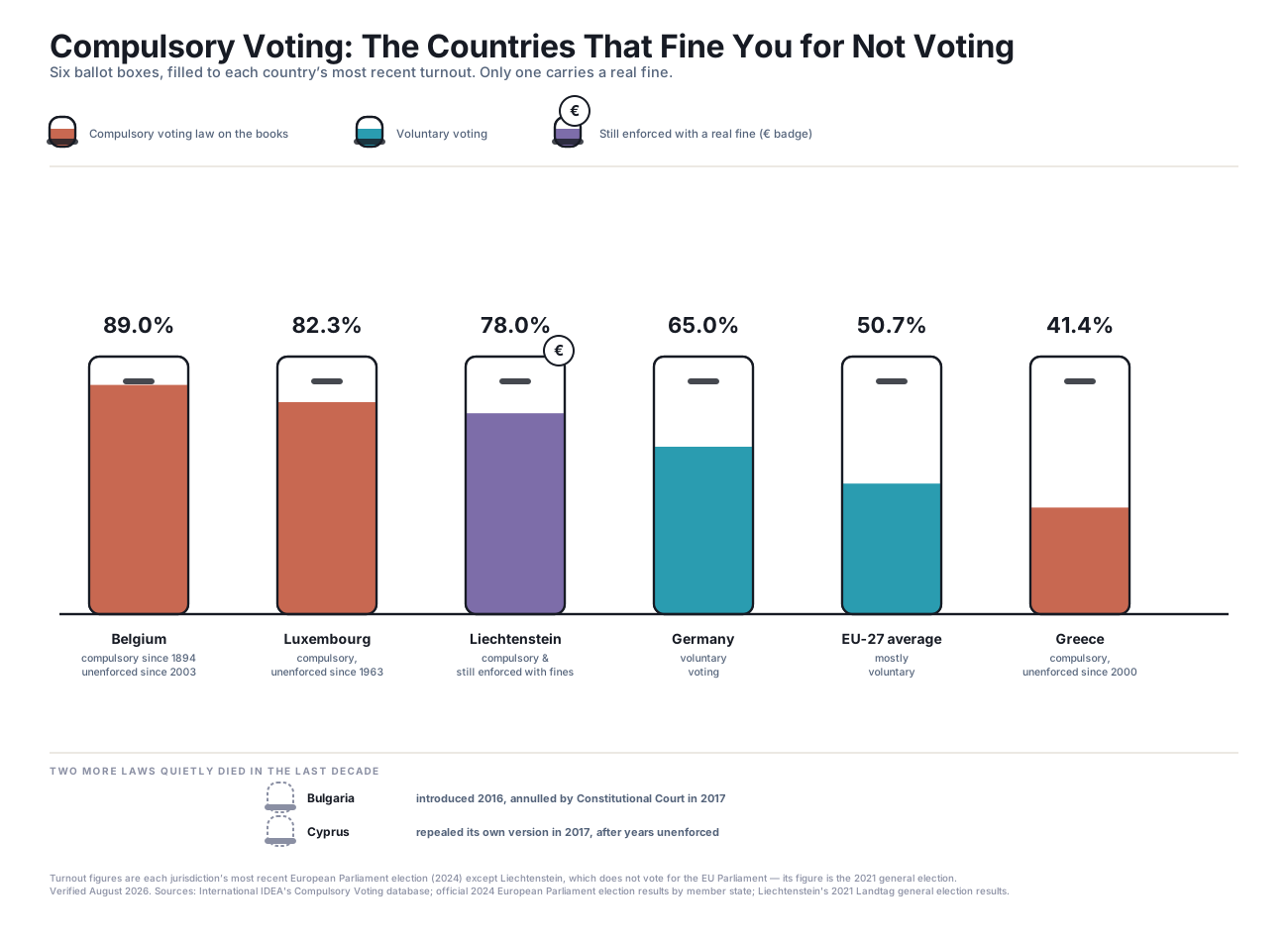
Six European jurisdictions have had a law on the books requiring citizens to vote: Belgium, Luxembourg, Greece, Liechtenstein and Bulgaria still do today, while Cyprus repealed its own version in 2017. Of the five still standing, only Liechtenstein still actually fines anyone. The other four haven't enforced a penalty in twenty years or more — and their turnout numbers show the law barely matters once the fine stops landing.
Two laws that stopped being enforced, and turnout didn't move
Belgium made voting compulsory in 1894, with fines historically running €40–80 for a first offence and up to €200 for repeat non-voters — but prosecutions stopped in 2003, and offenders are now almost never pursued. Turnout stayed high anyway: 89.0% in the 2024 European Parliament election, helped by automatic voter registration and a 2022 reform that lowered the voting age to 16 specifically for EU elections. Luxembourg's law carries a heavier fine on paper — €100–250 for a first offence, up to €1,000 for a repeat one — but no fine has actually been imposed since 1963. Its 2024 EP turnout, 82.3%, is barely dented by six decades of non-enforcement.
Greece breaks the pattern the other two seem to confirm
If a dormant law were enough on its own, Greece should look like Belgium or Luxembourg. It doesn't. Greece's compulsory-voting statute has carried no real sanction since 2000, and its 2024 European Parliament turnout was 41.4% — lower than the mostly-voluntary EU-27 average of 50.7%, and lower than voluntary Germany's 65.0%. A law with no enforcement behind it isn't a floor under turnout; Greece is the proof.
The one country that still cashes the fine isn't the highest
Liechtenstein is the only jurisdiction on this chart that both keeps compulsory voting and still enforces it — non-exempted voters who skip an election can actually be fined. Its turnout, 78.0% in the 2021 general election, is solid, but it sits below Belgium's and Luxembourg's numbers, both built on laws that haven't handed out a real penalty this century. That ordering is the whole finding: the actual threat of a fine doesn't buy Liechtenstein a turnout edge over two countries that dropped enforcement decades ago and never noticed the difference.
Cyprus repealed outright; Bulgaria only lost its fine
Cyprus repealed its compulsory-voting law outright in 2017, after it had sat unenforced for years. Bulgaria is a different story: its Constitutional Court struck down only the law's fines and sanctions in 2017, not the underlying legal obligation to vote. Bulgaria's own EU accession portal, the European Parliament's 2024-election briefing and International IDEA's database all still list Bulgaria as having a legally compulsory — if entirely unenforced — vote, putting it in the same category as Greece rather than Cyprus. Neither country's turnout data suggests either law is doing much at this point.
Frequently asked questions
Which European countries still have a compulsory-voting law?
Five still have one on the books: Belgium, Luxembourg, Greece, Liechtenstein and Bulgaria — though Bulgaria’s, like Greece’s, carries no working sanction. Cyprus repealed its own version in 2017.
Which country actually still fines people for not voting?
Only Liechtenstein. It’s the sole jurisdiction on the chart that both keeps compulsory voting and still enforces it — non-exempted voters who skip an election can actually be fined.
Does Belgium still fine non-voters?
No. Belgium made voting compulsory in 1894, with fines historically running €40–80 for a first offence and up to €200 for repeat non-voters, but prosecutions stopped in 2003 and offenders are now almost never pursued.
Why is Greece's turnout so low despite its compulsory-voting law?
Greece’s statute has carried no real sanction since 2000, and its 2024 European Parliament turnout was 41.4% — lower than the mostly-voluntary EU-27 average of 50.7% and lower than voluntary Germany’s 65.0%. An unenforced law isn’t a floor under turnout.
What happened to Bulgaria's and Cyprus's compulsory-voting laws?
Bulgaria introduced compulsory voting in 2016; its Constitutional Court struck down only the fines in 2017, not the underlying legal obligation to vote, so the law is technically still on the books, just as unenforced as Greece’s. Cyprus, by contrast, repealed its law outright in 2017, after it had sat unenforced for years.
Does a compulsory-voting law guarantee higher turnout?
Not once enforcement stops. Belgium and Luxembourg both post high turnout despite decades without a real fine, but Greece — under the same kind of dormant law — has the lowest turnout on the chart, well below several voluntary-voting countries.
Sources
International IDEA's Compulsory Voting database (enforcement status and fine amounts, verified August 2026); official 2024 European Parliament election results by member state (Belgium, Luxembourg, Greece, Germany, EU-27 turnout); Liechtenstein's 2021 Landtag general election results, via the national electoral authority.