 DAILYINFOGRAPHICS.EU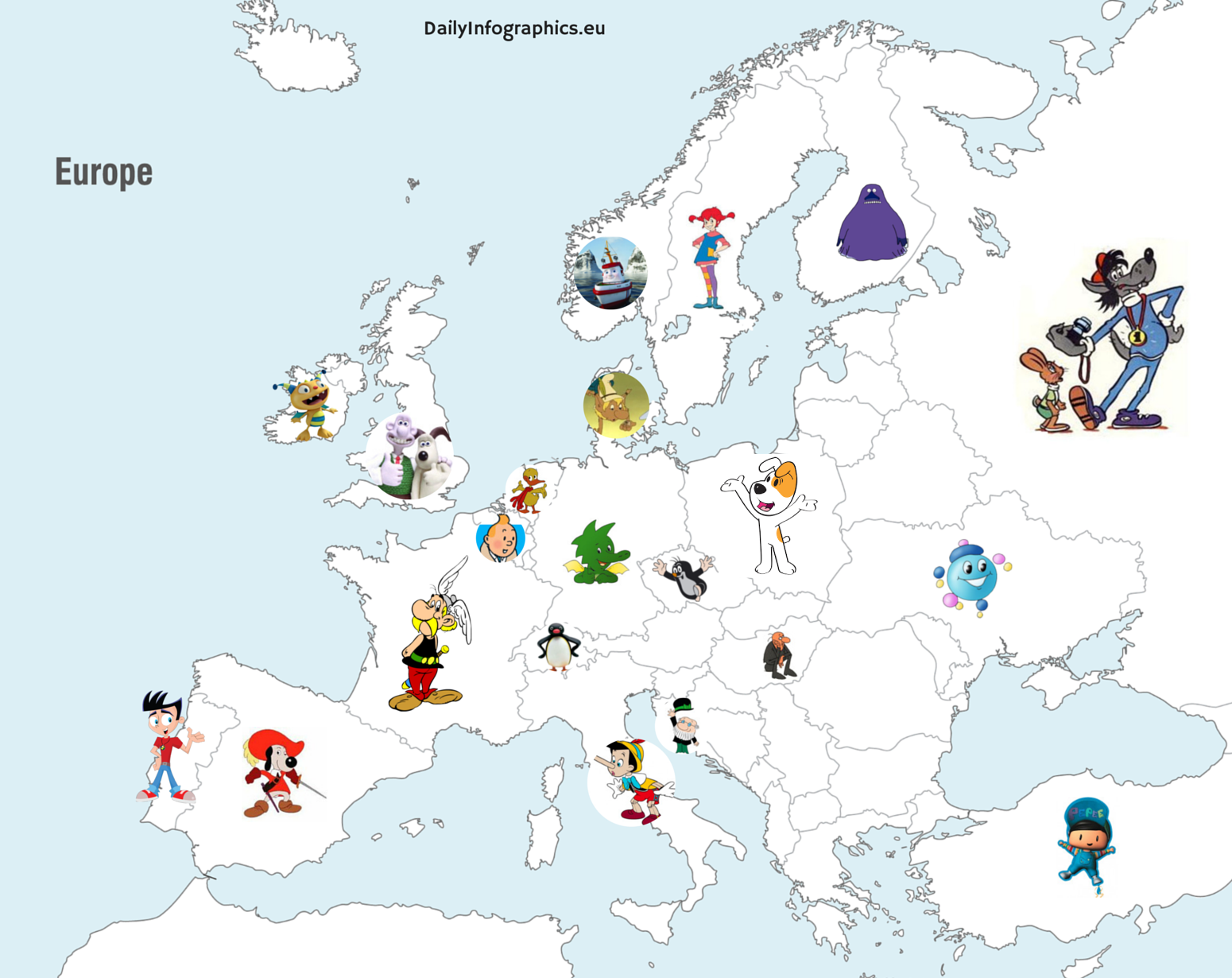
Cartoon characters travel further than almost any other export a country makes — a well-loved character keeps running in reprints, reruns and merchandise decades after the story that introduced them first aired. This map pairs 13 European countries with the character most closely identified with each one, from newspaper comic strips to stop-motion television.
The characters, country by country
United Kingdom: Paddington Bear, the Peruvian bear in the blue duffle coat who found his way to London. France: Asterix, the Gaulish warrior whose comic series began in 1959 and is still in print. Germany: Fix & Foxi, the mischievous fox twins who outwit their adversaries through cleverness rather than force. Italy: Topo Gigio, the small mouse with an outsized heart, created by Maria Perego. Spain: Pocoyo, the curious young boy who narrates his own small adventures.
Sweden: Pippi Longstocking, Astrid Lindgren's superhumanly strong redhead, in print since 1945. Denmark: The Little Mermaid, from Hans Christian Andersen's own telling. Norway: Reodor Felgen, the tinkering bicycle-repairman-inventor from Kjell Aukrust's Flåklypa Grand Prix (1975), Norway's most-watched homegrown film. Finland: the Moomins, Tove Jansson's family of round, gentle trolls. Greece: Perseus, reaching all the way back to the source material every other entry on this list eventually borrows from — mythology itself.
Russia: Cheburashka, the small, large-eared creature who has anchored Soviet and post-Soviet children's animation since the late 1960s. Poland: Reksio, the resourceful dog whose adventures have run since 1967. Czech Republic: Krtek, the Little Mole created by Zdeněk Miler, who has never spoken a word of dialogue in nearly 70 years of shorts.
Frequently asked questions
Why doesn't Krtek the Little Mole ever speak?
It was a deliberate creative choice by his creator, Zdeněk Miler. Krtek has never spoken a word of dialogue in nearly 70 years of shorts, which is part of why the character travelled so easily beyond Czechia.
How old is France's Asterix?
The comic series began in 1959 and is still in print today, making it one of the longest-running entries on this list.
Which countries on this list are represented by an animal rather than a person?
Two: Russia's Cheburashka, a small, large-eared creature, and Czechia's Krtek, the Little Mole. Every other country on the map is paired with a human character.
Why does Greece's entry go all the way back to mythology?
Perseus represents Greece here because the story reaches back to the source material every other entry on the list eventually borrows from in some form: mythology itself, rather than a 20th-century comic strip or television character.
Who created Pippi Longstocking, and when?
Astrid Lindgren created the superhumanly strong redhead for Sweden's entry; she has been in print since 1945.
Is the map graphic itself new, or from an older publication?
This infographic was first published in 2023. The map graphic is unchanged from its first publication.
Sources
Character origins and creation dates are matters of established public record for each named work (Astrid Lindgren, René Goscinny/Albert Uderzo, Zdeněk Miler, and others); the country-to-character pairings reflect the original 2023 editorial selection.